English
 Español
 tiếng việt
 русский
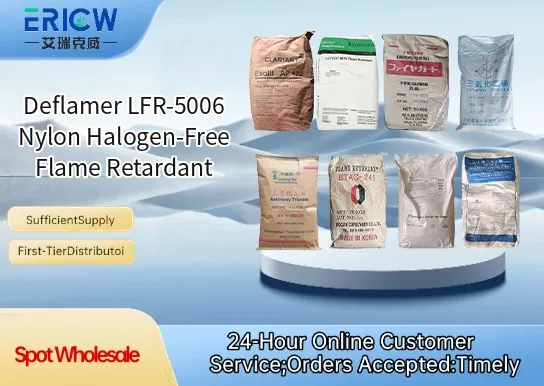
Phosphorus-nitrogen synergistic system enabling excellent flame retardancy in nylon 6 and nylon 66 matrices.
Halogen-free formulation meeting stringent environmental and regulatory requirements including RoHS, REACH, and UL 94 V-0 (at ≥15 wt% loading).
Low volatility and high thermal stability (>300 °C), ensuring minimal degradation during nylon melt processing.
Good compatibility with polyamide resins, supporting homogeneous dispersion without compromising mechanical properties.
Non-migrating design for long-term flame-retardant performance and surface integrity in finished parts.
Electrical connectors and housings for automotive ECUs and charging systems.
Consumer electronics enclosures requiring UL 94 V-0 rated nylon components.
Industrial automation housings and sensor brackets exposed to elevated ambient temperatures.
LED lighting fixtures and heat-dissipating structural parts in commercial lighting.
Railway interior components compliant with EN 45545-2 fire safety standards.
| Chemical Type | Organophosphorus-nitrogen compound |
| Product Form | Free-flowing white granules |
| Appearance | Off-white to light beige granules |
| Density | 1.45–1.55 g/cm³ (23 °C) |
| Decomposition Onset Temperature | ≥300 °C (TGA, 10 °C/min, N₂) |
| Recommended Loading Range | 12–18 wt% in nylon 6/66 |
| Moisture Content | ≤0.2 wt% (by KF titration) |
| Primary Applications | Flame-retarded engineering thermoplastics for electrical & transportation sectors |
Q1: What nylon grades is Deflamer LFR-5006 compatible with?
A: Deflamer LFR-5006 is specifically engineered for use in polyamide 6 (PA6) and polyamide 66 (PA66), including both unfilled and glass-fiber-reinforced grades. It demonstrates good dispersion and thermal stability during standard melt processing such as extrusion and injection molding.
Q2: How does LFR-5006 achieve flame retardancy without halogens?
A: LFR-5006 operates primarily through an intumescent mechanism in the condensed phase, promoting char formation and reducing fuel release during combustion. Its phosphorus- and nitrogen-based chemistry synergistically enhances thermal barrier development while avoiding corrosive or toxic halogenated decomposition products.
Q3: Does LFR-5006 affect the mechanical properties of nylon compounds?
A: When properly compounded, LFR-5006 typically preserves key mechanical performance—such as tensile strength and impact resistance—in PA6 and PA66 systems. Minimal effect on ductility and surface appearance is observed at recommended dosage levels, especially when combined with optimized stabilizer packages.
Q4: What is the typical dosage range for achieving UL94 V-0 rating?
A: Dosage depends on the base resin, filler content, and part thickness, but LFR-5006 is generally used at low concentrations—typically ranging from 0.1% to 2% by weight—to meet UL94 V-0 at 1.6 mm in unreinforced PA6/PA66. Optimization trials are recommended for each specific formulation.
Contact With Us:
E-mail: wangxingqiang@ericwchem.com
Have a Questions? Call Us:
Add:
Building A1, Jiete Industrial Park, Huangpu District, Guangzhou City, Guangdong Province, China