English
 Español
 tiếng việt
 русский
Category: Coatings & Inks Raw Materials · Target readers: coatings, ink and adhesive formulators, procurement and QC teams
Quick answer: Eastman™ CAB-381-0.5 is a low-viscosity cellulose acetate butyrate (CAB) resin used as a film-forming binder in solvent-borne coatings, printing inks, adhesives and specialty lacquers. Formulators specify grades of this type when they need fast solvent release, higher solids at a workable application viscosity, reliable pigment wetting and better colour stability than nitrocellulose. CAB-381-0.5 is usually blended with acrylic, polyester, alkyd, amino or isocyanate systems rather than used as a stand-alone binder.
Cellulose acetate butyrate is a thermoplastic cellulose ester produced by esterifying cellulose with acetic acid and butyric acid. It is supplied as a free-flowing powder or granule and dissolved into the solvent system of the coating or ink.
Eastman uses a three-part grade code for its CAB family. The first digits describe the balance of butyryl, acetyl and hydroxyl content in the ester backbone; the number after the hyphen describes solution viscosity. Within the CAB-381 family, a higher suffix means higher molecular weight and higher solution viscosity — CAB-381-0.5 sits at the low-viscosity end, alongside grades such as CAB-381-0.1, while CAB-381-2 and CAB-381-20 sit progressively higher.
Widely cited compositional figures for this grade are approximately 38% butyryl, 13.5% acetyl and 1.5% hydroxyl content. Confirm all figures against the current Eastman technical data sheet before specifying.
Two clarifications that matter in procurement discussions:
CAB is a binder/film-former, not a surface additive. It should not be evaluated as a substitute for a leveling agent, substrate wetting additive or defoamer.
CAB-381-0.5 is not a drop-in replacement for other CAB grades. Viscosity grade changes shift solution viscosity, solids loading, dry time and film build.
Renewable backbone. Cellulose is derived from wood pulp or cotton linters, which supports bio-based content targets in coating and packaging specifications.
High-solids enablement. Low-viscosity grades allow usable application viscosity at higher solids, which reduces solvent demand and supports low-VOC formulation targets.
Fast solvent release. Rapid evaporation and good film formation shorten flash-off and reduce dust pickup between coats.
Colour stability. Unlike nitrocellulose, CAB is not prone to self-oxidation and shows better resistance to yellowing during storage and service.
Broad compatibility. CAB is compatible with a wide range of acrylic, polyester, alkyd, amino and isocyanate systems, which makes it useful as a blending or "ladder" resin.
CAB-381-0.5 dissolves readily in esters (butyl acetate, ethyl acetate, isobutyl acetate), ketones (acetone, MEK, MIBK, cyclohexanone), glycol ethers and glycol ether acetates, and in aromatic hydrocarbons. Aliphatic hydrocarbons are generally used as diluents alongside true solvents rather than as sole solvents. The butyryl-rich ester backbone also improves compatibility with acrylic and polyester co-resins compared with lower-butyryl grades.
Because the 0.5 designation sits at the low end of the family, the grade can be formulated at elevated solids while keeping spray or print viscosity in range. In practice this translates into fewer coats for a given film build and shorter intervals between coats. Actual tack-free and through-dry times depend on solvent blend, film thickness, airflow and temperature and should be measured in your own system rather than assumed.
CAB-based films are used in exterior and semi-exterior applications where UV exposure and cleaning chemicals are a factor. Accelerated weathering programmes for CAB-containing topcoats commonly target 1,000–2,000 hours of xenon-arc exposure, but gloss retention and colour shift depend on pigment selection, co-resin ratio and film build. Resistance to mild alkaline cleaners and light solvent wiping is generally adequate for furniture and industrial equipment finishes.
Hydroxyl content of roughly 1.5% is low. This means CAB-381-0.5 behaves mainly as a physically drying blend resin; only a limited degree of crosslinking with amino resins or isocyanates should be expected from the cellulose ester itself. When formulating thermoset systems, the crosslinking density is normally carried by the acrylic or polyester polyol.
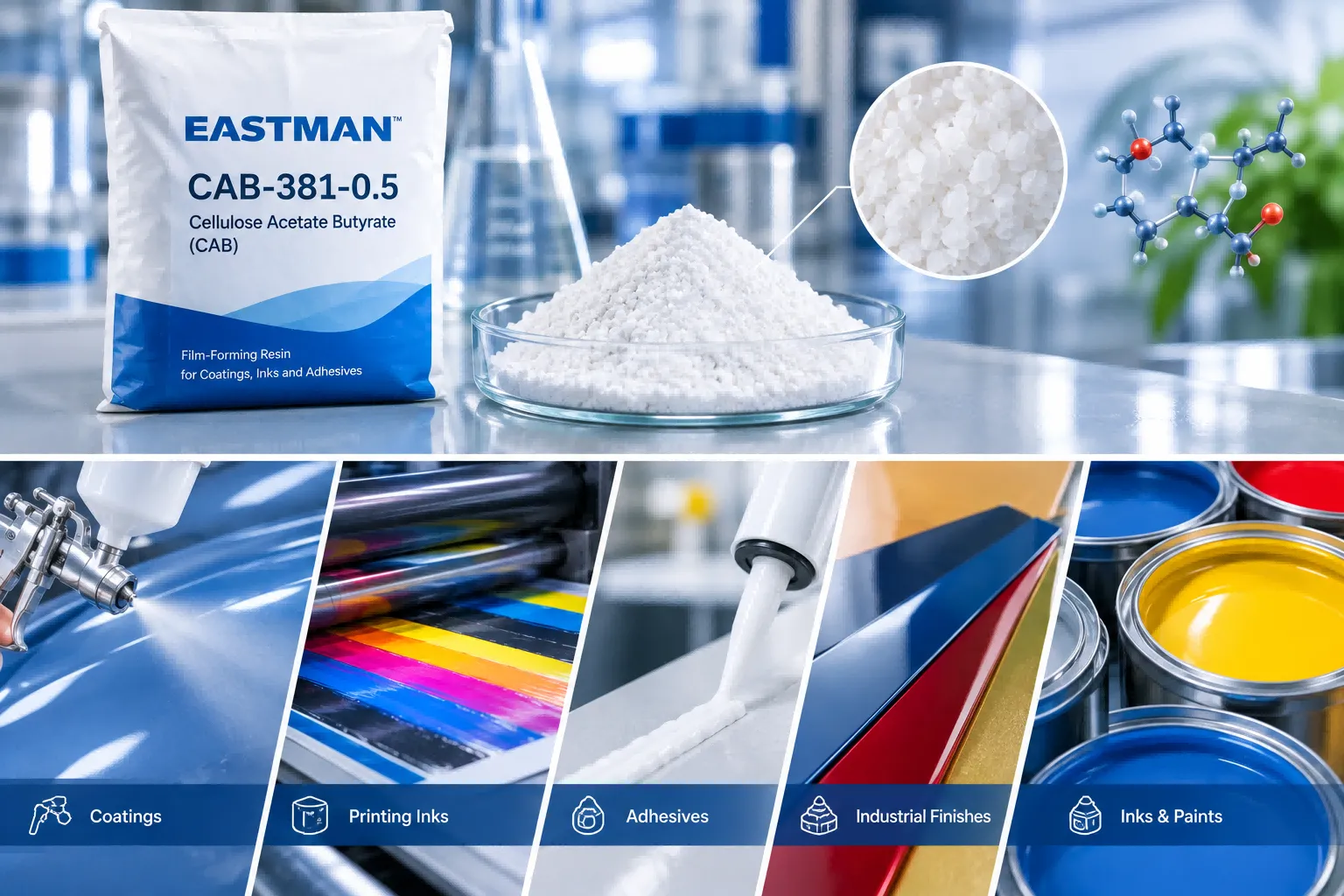
In refinish basecoats and clearcoat blends, CAB grades are used to control metallic pigment orientation, improve intercoat adhesion and shorten flash-off. CAB-381-0.5 is typically co-formulated with acrylic polyols and, where a thermoset cure is required, with amino resins in bake systems or with isocyanate hardeners in ambient-cure systems.
In wood lacquers, CAB improves sandability and recoatability and reduces the whitening and wrinkling issues sometimes seen with nitrocellulose systems. For clear coats, CAB is often combined with matting agents to achieve a defined gloss band; the achievable gloss range depends on matting-agent type and loading.
In gravure and flexographic inks, fast solvent release and pigment dispersion support high press speeds. CAB is also used in heat-seal lacquers and film coatings. Where a food-contact application is intended, note that CAB is listed among the base resins permitted under 21 CFR 175.300 (resinous and polymeric coatings) in the United States — final compliance depends on the complete formulation, substrate and end-use conditions, and must be assessed case by case.
Beyond coatings and inks, CAB grades are used in adhesive formulations, protective film coatings and specialty lacquers where film clarity, flexibility and low odour are required.
Solvent selection. Start from a true-solvent blend of ester and ketone, then use glycol ethers or glycol ether acetates as high-boiling tail solvents to control open time, leveling and gloss development. Aromatic hydrocarbons can be used to adjust evaporation profile and cost.
Co-resin pairing. Typical partners include acrylic polyols and solid acrylic resins, polyesters, alkyds, amino resins for bake systems and isocyanate hardeners for 2K systems.
Additive pairing. Rheology modifiers are used to control sag resistance and pigment settling; wetting and dispersing additives improve pigment and filler stability; leveling additives address surface defects introduced by the faster dry. Matting agents set the final gloss level. Because CAB shortens open time, additive choice should be re-evaluated whenever the CAB loading changes.
Cellulose esters are sensitive to moisture and heat. Recommended practice is to store sealed containers in a cool, dry area (commonly cited as at or below 25 °C and below 60% relative humidity), use stock on a first-in-first-out basis, and reseal partly used containers promptly. During development, verify dissolution completeness (clarity and absence of gels), solution viscosity by flow cup or Gardner-Holdt comparison, solids content, and tack-free and through-dry times under your actual line conditions.
Exact grade designation and lot number on the label, matching the COA.
Original packaging and country of origin, with no repacking between manufacturer and your warehouse.
Current TDS, SDS and COA for the specific lot, not a generic datasheet.
Documented distribution or authorization status for the brand and region.
Storage and shelf-life statement, plus the supplier's own warehouse conditions.
Sample availability and sample size so you can run compatibility and dry-time tests before committing volume.
Lead time, packaging format and total landed cost, including freight, duties and any repacking charge.
Technical support depth — can the supplier help with solvent balance, co-resin ratio or defect troubleshooting?
Guangzhou Eric Wei Chemical Co., Ltd. (brand: ERICW) operates as a platform-style specialty chemical supplier combining own-brand production, brand distribution and technical coordination. For formulators working with cellulose esters and related raw materials, the practical points are:
Brand distribution and documentation. The company reports authorized distribution of international brands including Evonik, BASF, Clariant, Croda, Wacker, Dow, Arkema, DuPont and Eastman, with original COA, TDS, MSDS and batch traceability documentation supplied with shipments.
Zero minimum order quantity policy. Samples and small orders from 1 kg or one drum are shipped, which suits pilot batches, multi-grade screening and small-volume specialty production.
Technical coordination. The company reports a strategic collaboration with the Hebei Waterborne Coatings Industrial Technology Research Institute, with access to more than 107 laboratory instruments and 100-plus patents for formulation support and analytical testing (XRD, NMR, GC-MS, SEM).
Digital tools. AI-assisted product selection is used to match application scenarios to candidate grades, reported at around 85% recommendation accuracy; batch reports and logistics tracking are available through digital traceability.
Logistics consolidation. Consolidated shipping and multi-item order bundling are reported to reduce logistics cost by 15%–30% for small and mid-sized buyers.
Recognition. Certified supplier status through Made-in-China with CTI on-site verification (October 2025), vice-chairman unit of the Hebei Adhesives and Coatings Association, and council member of the Guangzhou Anhui Anqing Chamber of Commerce.
Availability, authorization status and pricing for any specific grade should be confirmed directly before ordering.
Bio-based and renewable content targets are pushing formulators to re-examine cellulose esters as partial replacements for petro-based resins.
VOC and solvent reduction rules continue to favor low-viscosity grades that allow higher solids.
Hybrid and waterborne systems increasingly use CAB as a co-resin for rheology, metallic control and open-time adjustment.
Regulatory documentation (REACH, RoHS and food-contact requirements) is now a routine part of raw material qualification, making document-ready suppliers a practical advantage.
Founded in 2024 and headquartered in Guangzhou, China, ERICW supplies resins, additives, pigments, fillers and solvents to coating, ink, adhesive, plastics and rubber manufacturers. The company operates on a combined model of own-brand production, international brand distribution and technical support, with a zero-minimum-order policy and international shipping capability.
Contact: wangxingqiang@ericwchem.com · https://www.ericwchem.com
Disclaimer
This material is for marketing reference only and does not replace professional technical, legal or procurement advice. Product parameters, prices, certifications and supply status vary by batch and market. Customers must check official TDS/SDS/COA and perform self-testing before purchase.
All stated performance data and business information require independent verification. All trademarks are proprietary to their respective holders without implied partnership or endorsement.


Vice Chairman of the Coatings and Adhesives Association
Senior New Materials R&D Engineer
Bachelor of Engineering
General Manager
Professional Experience: With 10 years of experience in the fine chemical industry, the team has served over 10,000 clients. Committed to providing one-stop fine chemical services for global clients and helping them optimize the selection of chemical materials.